
College Governance

Corporate and Academic Governance
Corporate Governance Arrangement
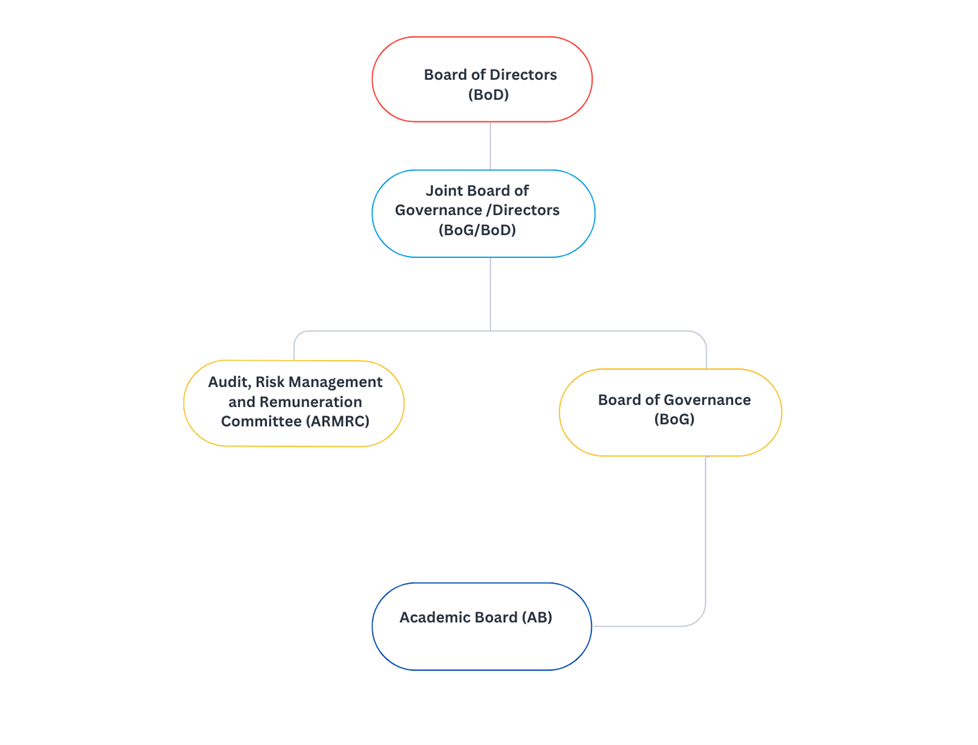
Board of Directors (BoD)
The Board of Directors is the governing body of 91³Ô¹ÏÍø Ltd and is appointed by the shareholders in accordance with the Articles of Association. It is unambiguously and collectively accountable for the College’s activities, long-term success, statutory oversight, financial sustainability and regulatory compliance. The BoD takes all final decisions on matters of fundamental concern within its remit and ensures that directors discharge their regulatory, fiduciary and general duties.
The BoD ensures that the College operates openly, honestly, accountably and with integrity and applies the principles of the Independent Higher Education Code of Governance. It establishes and maintains the Board of Governance, ARMRC and the Academic Board and approves the Scheme of Delegation defining their respective roles, responsibilities and authority.
The BoD approves the College’s vision, mission, strategic goals, objectives and key performance indicators and monitors their delivery. Through the BoG and explicit reporting arrangements with the Academic Board, it receives and tests assurance that academic governance, teaching and learning, academic quality and standards and the student experience are adequately governed and effectively supported. Refer to the BoD Terms of Reference for further details:
Board of Governance (BoG)
The Board of Governance (BoG) assists and supports the Directors and College Principal in their oversight and direction of all aspects of educational activity. It also provides independent advice on strategic direction, ensuring compliance with regulatory requirements from the Office for Students (OfS), awarding bodies, and other regulators. It provides independent scrutiny and advice in relation to institutional strategy, academic governance, academic quality and standards, regulatory compliance, equality, diversity and inclusion, and the student experience.
The BoG assists, supports and advises the BoD to ensure that the College operates transparently, delivers high-quality education, and complies with its conditions of registration. Additionally, it advises on the arrangements for financial sustainability and the management of public funds in a manner that provides value for money.
The BoG oversees the development of the College’s vision, mission, strategic objectives and key performance indicators and recommends these to the Board of Directors for approval. It receives regular reports from the Principal on delivery of the Strategic Plan and progress against agreed KPIs. The BoG sets, develops or recommends, as appropriate under the Scheme of Delegation, and monitors academic KPIs and scrutinises student data, including recruitment, retention, continuation, completion and outcomes.
The BoG actively seeks and receives assurance from the Academic Board that academic governance, teaching and learning, academic quality and standards are robust and effective. It reports this assurance to the Board of Directors, receives and considers Academic Board minutes, approves the Academic Board Terms of Reference and advises the Board of Directors on academic quality and standards, the student experience and the resources required to support high-quality tuition. Refer to the BoG Terms of Reference for further details:
Audit, Risk Management and Remuneration Committee (ARMRC)
The Audit, Risk Management and Remuneration Committee provides independent oversight and assurance to the Board of Directors in relation to external audit, financial sustainability, internal control, corporate risk management, value for money and senior staff remuneration. It reviews the annual report and financial statements, including the external auditor’s opinion, the statement of members’ responsibilities, the statement of internal control and any significant control issues. It also oversees the scope, nature and conduct of the external audit and advises the Board of Directors on the appointment of external auditors when required.
The ARMRC reviews the adequacy and effectiveness of the College’s internal control and corporate risk management arrangements. It reviews the Corporate, Academic and Prevent Risk Registers at each meeting and undertakes detailed scrutiny of the College’s most significant risks, including their potential impact on financial health, reputation, operations and regulatory compliance. Where necessary, particularly in the absence of a formal internal audit function, the Committee may commission proportionate internal assurance work or independent assessment.
Refer to the ARMRC Terms of Reference for further details:
Board of Governance:
Executive Members
-ÌýNazim Uddin
-ÌýShiraj Islam
Non-Executive Members
-ÌýLinda Felton
Audit, Risk Management and Remuneration Committee (ARMRC)Â
Non-Executive MembersÂ
-ÌýStuart Trow
Board of Directors
Executive DirectorsÂ
-ÌýNazim Uddin
-ÌýShiraj Islam
Non-Executive DirectorsÂ
Schedule of the Board meetings:
-ÌýThe 39th Board meeting is scheduled on 25th November 2026
-ÌýThe 38th Board meeting was held on 22nd July 2026
-Ìý
-Ìý
-Ìý
-Ìý
Academic Governance Arrangement
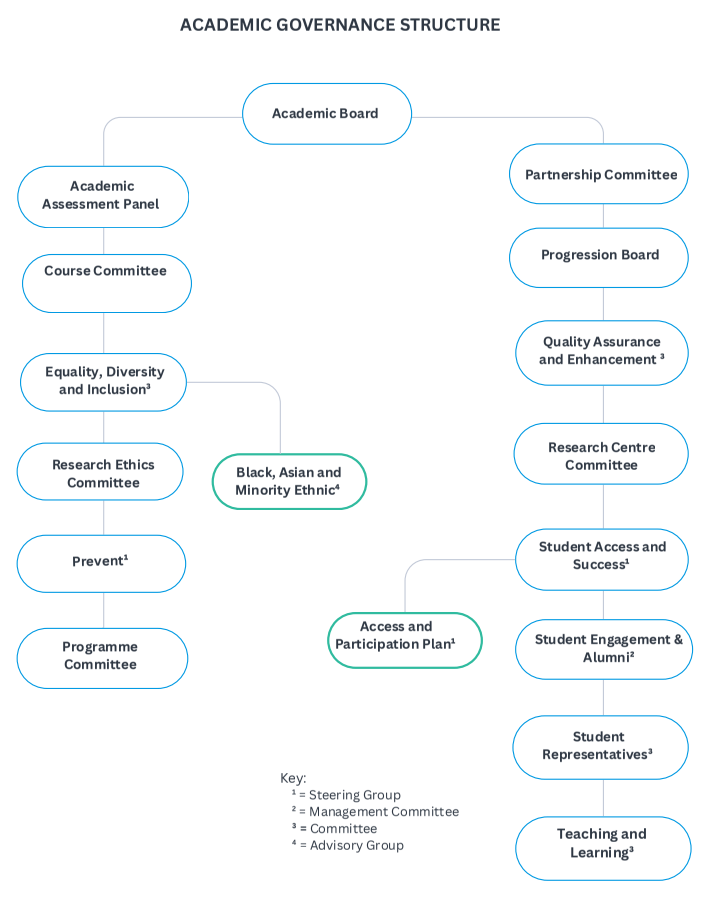
Academic Board
The Academic Board is the principal academic body of the College and has oversight and responsibility for its local regulatory frameworks, policies and procedures, as well as for the management of academic standards and quality. The Academic Board aims to meet the expectations of the College’s external stakeholders, more especially in relation to the quality of the student experience and the academic standards of the programmes taught.
The Academic Board has 14 committees reporting to it:
1. Academic Assessment Panel
The Academic Assessment/Re-Assessment Panel is responsible for reviewing students’ results, cases of extenuating circumstances and approving students’ results for transmission to London Metropolitan University.
2. Partnership Management Committee
The Partnership Management Committee (PMC) provides strategic oversight of the academic, operational, and student experience related aspects of the partnership. The Committee ensures that the partnership operates in alignment with university regulations, quality assurance requirements, and strategic priorities. It serves as the primary forum for evaluating partnership performance, monitoring delivery standards, and coordinating enhancement actions.
3. Course Committee
A Course Committee is formed for each London Metropolitan University course and advises academic leaders on the management and general operation of undergraduate/postgraduate courses within its subject area. The committee focuses on course development, while Subject Standards and Awards Boards handle assessment and awards. Each course belongs to only one committee.
4. Progression Board
A Progression Board meets prior to the commencement of teaching for the academic year two. The purpose of the Progression Board is to review the students’ academic performance to make progression decisions from year one to year two.
5. Quality Assurance and Enhancement Committee
The Quality Assurance and Enhancement Committee (QAEC) is responsible for ensuring that the College’s quality assurance systems meet the expectations of the UK Quality Code, awarding bodies, students and other internal and external stakeholders.
6. Equality, Diversity, and Inclusion Committee
The purpose of the Equality, Diversity and Inclusion Committee (EDIC) is to ensure the College complies with the Equality Act 2010 and the College Equality and Diversity Policy, and to make recommendations as it deems necessary.
a. Black, Asian and Minority Ethnic Advisory Group
The Black, Asian and Minority Ethnic (BAME) Advisory Group has been established to advise the College on the type of support required for BAME students throughout the student lifecycle. The group where necessary will advise the College’s Equality and Diversity Committee which reports to the Academic Board. The Black, Asian and Minority Ethnic Advisory Group reports to the Equality and Diversity Committee.
7. Research Centre Committee
The NCL Research Centre (NCLRC) oversees and coordinates the development and implementation of 91³Ô¹ÏÍø’s strategy for curricular and non-curricular research activities.
8. Ethics Committee
The Ethics Committee considers issues relating to research undertaken by undergraduate and postgraduate students which raise ethical questions, and to teaching issues in which ethical issues may surface. The Ethics Committee submits an annual report to the Academic Board.
9. Student Access and Success Steering Group
The purpose of the Student Access and Success Steering Group (SASSG) is to monitor the implementation and evaluation of the College’s Access and Participation Plan, as approved by the Office for Students, and to make recommendations as it deems necessary.
a. Access and Participation Plan Steering Group
The purpose of the Access and Participation Plan Steering Group (APPSG) is to scrutinise the College’s Access and Participation Plan (APP) documentation and monitor the progress made against the targets and commitments made within it. The group is mandated to provide support and guidance to the teams working in Access, Success and Progression delivery. The APPSG will report to the Student Access and Success Steering Group.
10. Prevent Steering Group
The purpose of the Prevent Steering Group is to ensure that the College meets the requirements of the Office for Students in relation to the College’s statutory and regulatory responsibilities concerning the monitoring and prevention of violent extremism across the College.
11.Student Engagement & Alumni Management Committee
The NCL Student Engagement & Alumni Management Committee (SEAMC) is responsible to coordinate the planning and implementation of all activities under the Student Engagement Framework. The SEAMC will have a say on key aspects of student life through various themes such as student events, student representation, student support, extra-curricular activities and Non-Curricular and Leisure Activities.
12.Programme Committee
A Programme Committee is formed for each HND Programme the College delivers. The Programme Committees report to the Academic Board and are responsible for managing the day-to-day academic quality and standards of the programmes, and for ensuring effective engagement with students on programme-related matters.
13.Student Representatives Committee
The Student Representatives Committee (SRC) provides a forum in which students can express their views on their learning experience at the College.
14.Teaching and Learning Committee
The Teaching and Learning Committee provides a forum for academic and support staff to collaborate in enhancing teaching, learning, and pedagogy at the College. It promotes sector best practice and innovation in curriculum management and academic development. The committee makes recommendations to the Academic Board on course development and partner approvals, ensuring quality and standards are maintained.
Team Members
-

Roger Bradburn
Principal | Executive member Board of Governance | Chair of Academic Board | Chair of Senior Management Team
-

Athiqul Islam
Director / Executive Member of Board of Governance / Head of Finance/HR/ Safeguarding Officer for Staff
-

Shiraj Islam
Director / Executive Member of Board of Governance / Head of Marketing
-

Nazim Uddin
Director / Executive Member of Board of Governance / Head of Quality Assurance


